
Foundation(al) Industries
You may have noticed that Lucy and I are slowly moving away from using the term Foundation Industries, and more often than not referring to the collective of the metal, chemical, paper, glass, ceramics, and cement industries as the Foundational Industries.
For those of you who have taken the time to dive into the Modern Industrial Strategy, you may have realised why: although not all of the above industries are mentioned directly, the Foundational Industries are referenced as being vital to the competitiveness of Advanced Manufacturing businesses and as playing a critical role in enabling the UK economy.
As these industries are key to delivering the country's net-zero targets, innovation is required to enable low-carbon production, promote recycling and reuse, and to support resource efficiency to reduce emissions. By establishing resilient supply chains, innovation from the foundational industries can support the clean energy transition.
We've spent considerable time reflecting on how FISC's initial aims align with the new strategy. As a result, we've revamped FISC's focus areas to better align with both the Industrial Strategy and our wide-ranging capabilities.
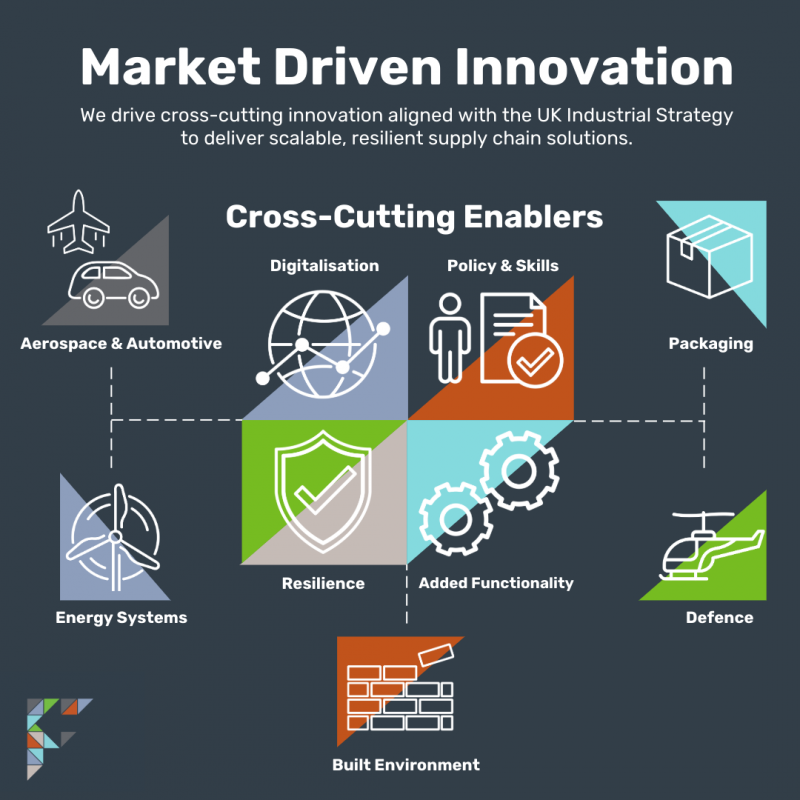
There has also been a visible shift in language away from a circular economy to resilience. Recent global disruptions have highlighted the importance of resilient domestic supply chains, and the foundation industries are key to reducing the UKs reliance on imports and strengthening national economic security.
So, while the foundational industries may not be the headliners of the strategy, it is clear delivery cannot happen without them, and that innovation and commercialisation within these industries are vital. They will not only enable net-zero but also drive broader economic growth, create exciting jobs, and ensure long-term security for the UK.
Published: 05-12-2025
Latest - Impact
FISC is working with industry to help them solve problems relating to six key themes. In this case study partner Lucideon is driving energy efficiency through advanced modelling and data science.
Let's be honest, when we talk about innovation in the foundational industries, the conversation often jumps straight to tech; new processes, low-carbon materials, AI-driven optimisation. But here's the thing, none of it scales without people. From ideation to implementation, the scale-up and commercialisation of sustainable technologies in these sectors depend on human ingenuity, cross-sector collaboration, and leadership.
When taking over as Co-Directors of FISC, Sarah and I wanted to address the values of the consortium and align them to our own values and the needs of the industries that we serve. To become the voice of innovation across the foundational industries, we have to make sure that every voice is heard. So we made "People Powered Progress" one of our three core values.
What do you think of when you hear the word innovation? A shiny new technology? A clever app? A robot doing something fancy? In some cases, that's true, but for the foundational industries innovation often takes the shape of a new material formulation or a new conversion process; innovation is not always visible, but it has a big impact. That impact needs to be measurable, scalable, and game-changing to support the journey to net zero.
As Dr Sarah Harrold reminds us, innovation isn't always flashy or immediately visible.

© FISC
Keep up to date, sign up to our mailing list